

New cosmetic ingredient update: Research on cyclic peptides for skin health and brightening effects
Publish Time:
2025-10-17
Peptides boast advantages such as low molecular weight, mildness, non-toxicity, and excellent absorbability, while also exhibiting multiple bioactivities—including antioxidant, anti-aging, and free-radical-scavenging properties—making them widely used in cosmetics. Generally speaking, peptides can be classified into two main structural types: linear peptides and cyclic peptides. Currently, linear peptides dominate the peptide formulations applied in cosmetic products. However, due to their unique structural characteristics, linear peptides often face certain limitations in practical applications. Primarily, linear peptides contain free polar groups (such as amino and carboxyl groups), resulting in strong hydrophilicity. Given the skin's inherently lipophilic nature, linear peptides typically exhibit poor permeability. Moreover, most peptides are readily degraded by proteases present in skin tissues, breaking down into smaller fragments or short peptides that lose their original efficacy. As a result, these peptides struggle to remain effectively retained in the skin for extended periods, leading to their relatively low bioavailability. Additionally, since the commonly available peptide targets in the market tend to be relatively limited in scope, manufacturers often opt for synergistic combinations of multiple peptides in order to achieve comprehensive anti-aging effects. Cyclic modification of peptide molecules is considered an effective strategy to address the limitations of linear peptides. By cyclizing peptides, their resistance to enzymatic degradation can be significantly enhanced, allowing them to maintain stable biological conformations and exhibit superior bioactivity. In fact, some cyclic peptides demonstrate improved skin penetration compared to their linear counterparts. Currently, however, the use of cyclic peptides in cosmetics remains relatively rare. Domestically, only three cosmetic-grade ingredients are currently available: cyclopeptide-161, cyclohexapeptide-9, and cyclohexapeptide-24 amino-cyclohexane carboxylic acid ester.
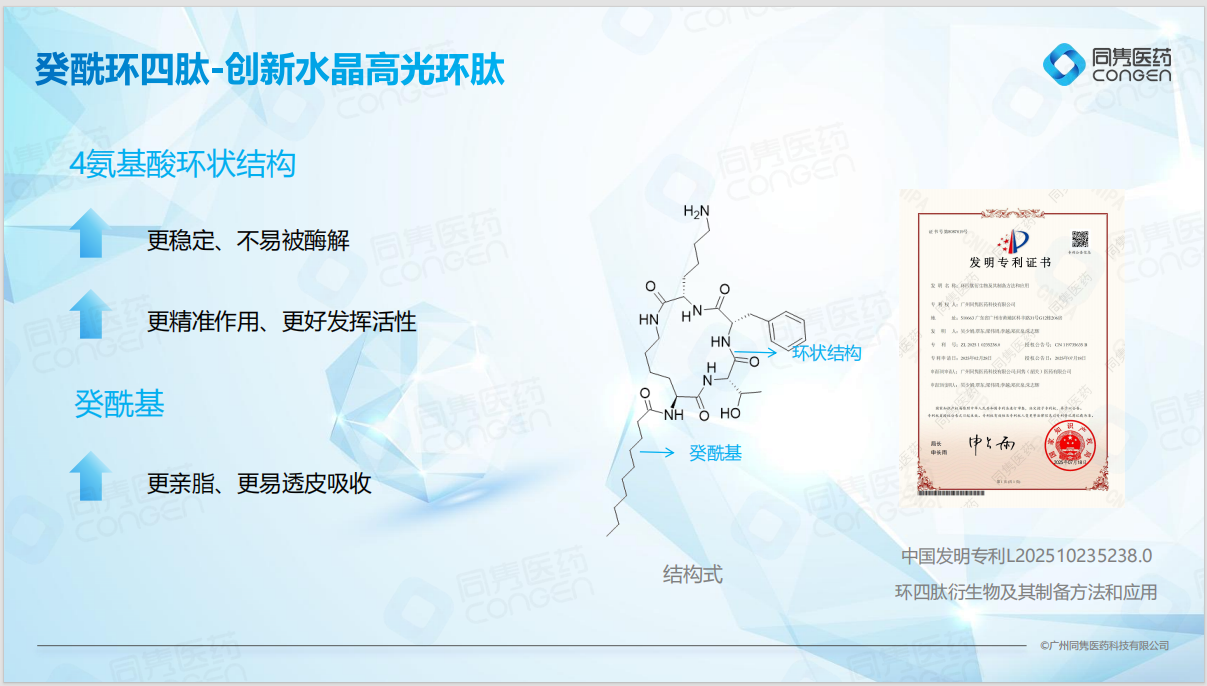
Recently, CongenPharma's independently developed decanoyl cyclo-tetrapeptide has been granted an invention patent in China. Patent No.: ZL202510235238.0. This innovative ingredient, dubbed the "Crystal High-Glow Peptide," offers a groundbreaking scientific solution for achieving "radiant, crystal-clear skin."
Why is "Decanoyl cyclotetrapeptide " the scientific answer for lean muscle?
1. Stability
→ The cyclic structure resists enzymatic degradation, resulting in longer-lasting activity.
2. Gentle and Efficient
→ The safe concentration is four times that of linear peptides, making it ideal for use on fragile muscles;
→ Ring-shaped structures are more likely to dock precisely at the receptor site, enabling targeted action.
→ Better transdermal absorption, making it easier for the skin to take in.
Triple Highlight Engine Creates "Crystal Skin"
→ Even, Clear, and Radiant: Boosts alpha-crystallin protein while reducing the buildup of damaged proteins, leaving skin translucent and glowing like crystal.
→ Strengthen the barrier: Promote filaggrin production, making the stratum corneum dense and resistant to damage, Presenting healthy beauty;
→ Hydrated Radiance: Boosts hyaluronic acid for exceptional moisture retention, leaving skin soft, supple, and glowing.

Comparative experiment: Cyclic tetrapeptide outperforms linear peptide
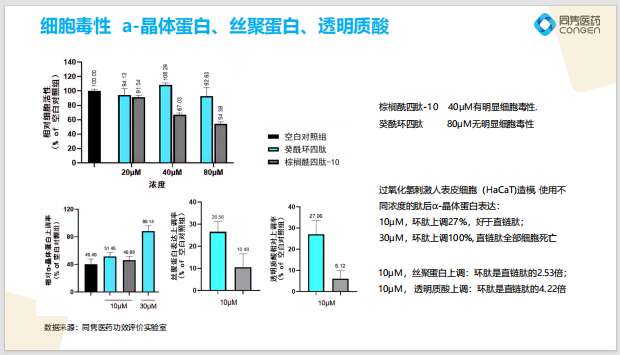
Cytotoxicity is reduced, and the safe concentration is four times higher than that of linear peptides.
The linear tetrapeptide exhibits significant cytotoxicity at 80 μM, reducing cell viability to about 55%. In contrast, the cyclized tetrapeptide shows markedly reduced toxicity toward cells, with no notable cytotoxic effects observed even at the same concentration of 80 μM, demonstrating excellent biocompatibility.
α-Crystallin protein increased 2.06-fold
Using hydrogen peroxide to induce a model in human epidermal cells (HaCaT), the experiment revealed that decanoyl cyclo-tetrapeptide enhanced α-crystallin protein expression 2.06 times more effectively than palmitoyl tetrapeptide-10.
Fibroblast-specific protein increased 2.53-fold, while hyaluronic acid levels rose 4.22-fold.
Innovative raw materials, collaborative application for approval
Contact us email:shine@congenpharm.com
Relevant Information

undefined