

Custom-formulated new cosmetic ingredient—CongenPharma Crystal High-Circle Peptide: Breaking the limitations of linear peptides and paving a new path for peptide applications in cosmetics.
Publish Time:
2025-10-17
In the cosmetics industry, peptides have become a highly favored ingredient due to their advantages: low molecular weight, mildness, non-toxicity, and excellent absorbability. Additionally, they boast a wealth of bioactive properties, including antioxidant, anti-aging, and free-radical-scavenging effects. For years, linear peptides have been the mainstream type of peptide used in cosmetics. However, as technology advances, their inherent limitations have gradually become more apparent. Meanwhile, cyclic peptides—offering an effective solution to address the shortcomings of linear peptides—are increasingly gaining attention within the industry, paving the way for innovative new directions in peptide-based cosmetic applications.
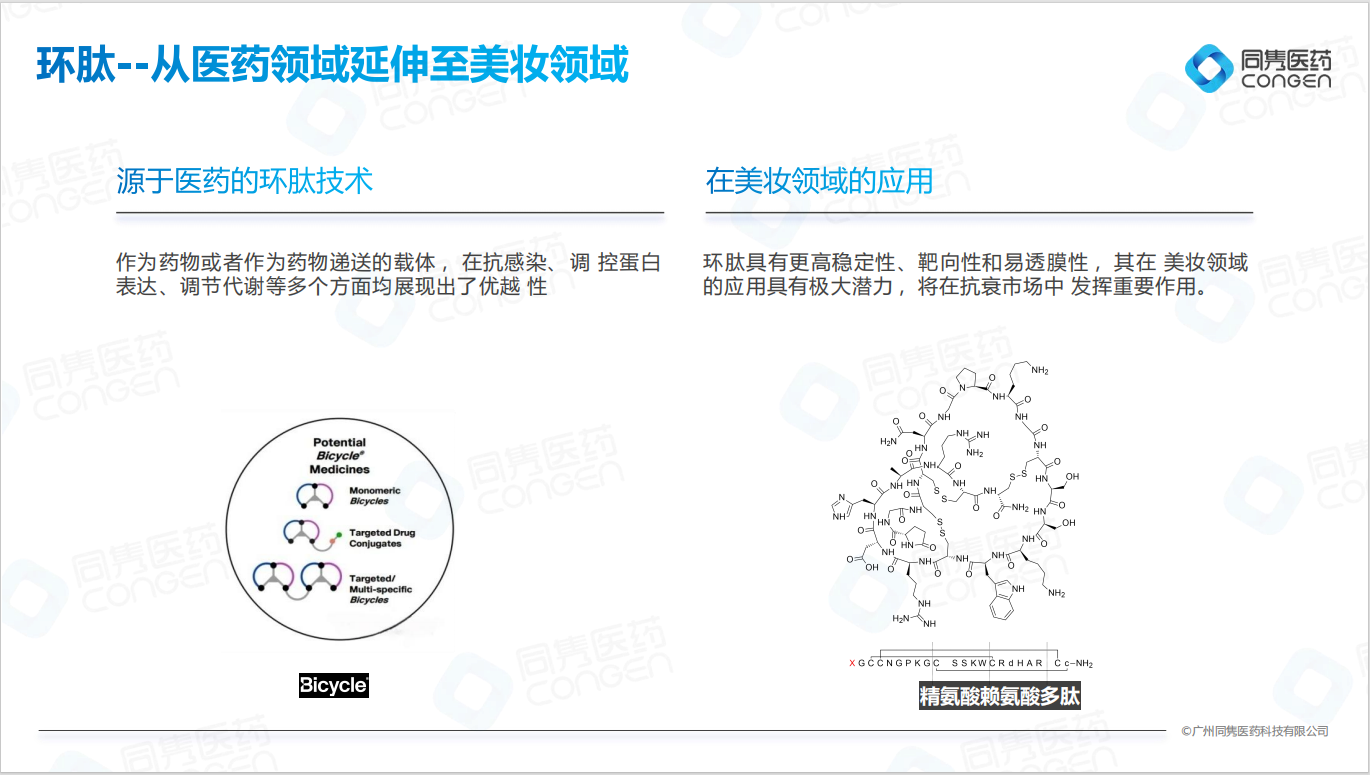
Straight-chain peptides: The mainstream choice for cosmetic peptides, yet constrained by multiple challenges.
Straight-chain peptides, with their relatively mature development, have long dominated the majority share of the cosmetic peptide market and are widely used in skincare applications such as anti-aging and repair. However, limitations stemming from their inherent structural characteristics continue to hinder the full realization of their efficacy.
Poor permeability makes it difficult for straight-chain peptides to penetrate deep into the skin: The structure of straight-chain peptides contains free amino and carboxyl groups—highly polar functional groups—that give them strong hydrophilic properties. However, since skin naturally exhibits lipophilic characteristics, this structural contrast creates a significant barrier, preventing straight-chain peptides from effectively crossing the skin's protective layer and reaching deeper layers to deliver their intended effects.
Easily degraded and poorly bioavailable: Once introduced into the skin, most linear peptides are broken down into fragments or short peptides by proteases present in skin tissues, thereby losing their original biological activity. This significantly hinders the ability of linear peptides to accumulate in high concentrations within the skin, ultimately resulting in low bioavailability and severely diminishing their effectiveness.
The target is singular, requiring synergistic enhancement through formulation: Commonly available linear peptides on the market have relatively limited efficacy targets. To achieve comprehensive skincare benefits such as multi-dimensional anti-aging effects, they must be combined with other ingredients in a synergistic formulation—thus increasing both the complexity and cost of product formula design.
Cyclic Peptides: Solving the Challenges of Linear Peptides, Highlighting Cosmetic Application Advantages
Cyclization modification of peptides is widely regarded in the industry as an effective approach to overcome the limitations of linear peptides. By introducing cyclization, cyclic peptides achieve comprehensive improvements in stability, permeability, and biological activity, making them better suited to meet the efficacy demands of cosmetic applications compared to their linear counterparts.
Circular peptide core advantages: A comprehensive breakthrough—from structure to functionality
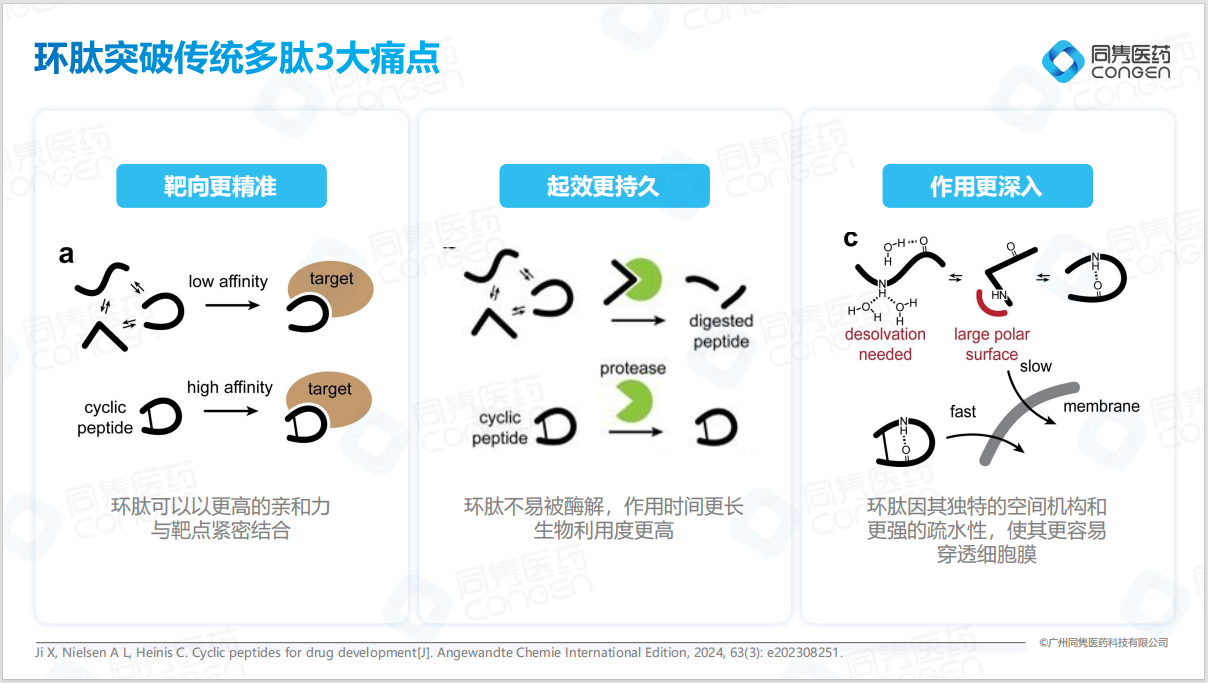
Enhanced resistance to enzymatic degradation and improved stability: The cyclized peptide forms a stable biological conformation, effectively shielding it from breakdown by skin proteases, significantly prolonging its activity on the skin and minimizing the loss of potency.
Permeability optimization ensures direct access to the target: After cyclization, certain peptides become more hydrophobic, better matching the skin's lipid-friendly nature. This enhanced compatibility allows them to penetrate the skin barrier and reach deeper layers, effectively addressing the core issue of linear peptides being unable to "get in."
Biological activity is superior, with more pronounced efficacy: The stable conformation allows cyclic peptides to bind tightly to their targets with higher affinity, while some cyclic peptides even achieve effects that are difficult for linear peptides to attain. For instance, Jujun Pharmaceutical’s decanoyl cyclo-tetrapeptide, at a specific concentration, boosts filaggrin expression 2.53 times more effectively than the linear peptide palmitoyl tetrapeptide-10—and its ability to enhance hyaluronic acid production is an impressive 4.22 times greater. This makes it highly effective in strengthening the skin barrier and deeply replenishing moisture, ultimately delivering superior results for skin health and hydration.
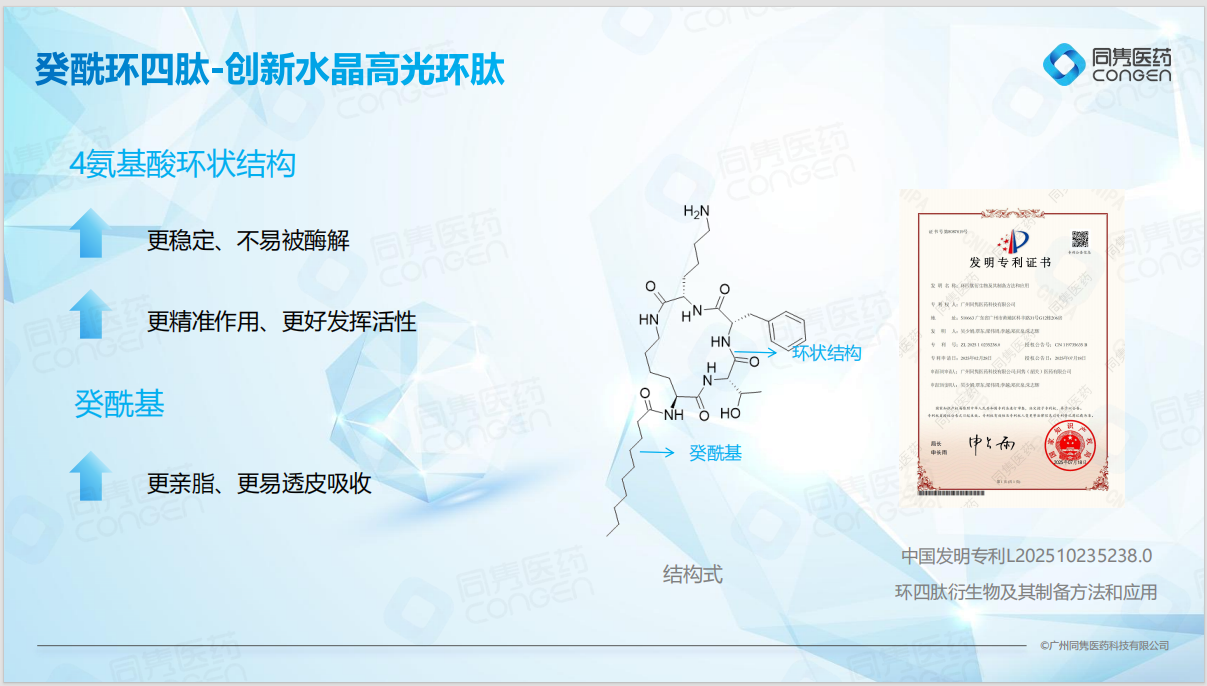
Jun Pharmaceutical's Cyclic Peptide Practice: Efficacy Validation Using Decanoyl Cyclotetrapeptide as an Example
Tongjun Pharmaceutical has already conducted extensive and mature explorations in the field of cyclic peptide applications. Its newly developed decanoyl cyclo-tetrapeptide demonstrates outstanding skincare efficacy, providing strong support for the use of cyclic peptides in cosmetic products.
Strengthening the skin barrier to defend against external irritants: Decyl cycletetrapeptide promotes the production of filaggrin, a protein that not only fortifies the skin barrier and prevents moisture loss but also acts as a robust shield, blocking allergens and pathogens from penetrating the skin and reducing the risk of skin sensitivity. Meanwhile, when filaggrin breaks down, it transforms into natural moisturizing factors (NMF), further enhancing the skin's ability to retain moisture and keeping it in a healthy, well-nourished state.
Enhance skin transparency for a radiant, luminous glow: Similar to another cyclopeptide ingredient from Tongjun Pharmaceutical—Palmitoyl Tetrapeptide-10—Decanoyl Cyclo-tetrapeptide also boosts skin clarity by stimulating the molecular chaperone protein α-crystallin. At the same time, its micro-polishing effect helps achieve an even, glowing complexion, delivering a "translucent aesthetic that reveals your skin’s inner radiance—bright and clear as light passing through crystal."
Highly safe with no cytotoxicity concerns: Verified by Tongjun Pharmaceutical's Efficacy Evaluation Laboratory, decylcycletetrapeptide exhibits no significant cytotoxicity within its effective concentration range, whereas linear peptides cause complete cell death even at a concentration of 10 μM, clearly demonstrating the safety advantages of cyclic peptides.
Cyclic peptide applications in cosmetics: Promising prospects, yet still needing to overcome industry bottlenecks.
Currently, the application of cyclic peptides in cosmetics is still in its early stages. Domestically, there are only three cosmetic ingredients available: cyclic peptide-161, cyclohexapeptide-9, and cyclo-tetrapeptide-24 amino-cyclohexane carboxylate. Large-scale applications have yet to be established, and the core limiting factors remain focused on two key areas.
Higher costs limit commercial adoption: The cyclization process for cyclic peptides is complex, resulting in R&D and production costs that are significantly higher than those of linear peptides. This drives up the cost of cosmetics incorporating cyclic peptides, making it challenging to introduce them widely into the mass market.
Uncertainty in efficacy increases R&D risks: After cyclization, different peptides exhibit varying levels of effectiveness—some may fail to deliver the expected results, while others even show reduced efficacy. This unpredictability has prompted companies to adopt a cautious approach toward cyclic peptide research and application, thereby slowing down the pace of their commercialization efforts.
However, with advancements in technology—such as the optimization of cyclic peptide synthesis processes and the refinement of efficacy screening systems—the challenges of high costs and uncertain efficacy associated with cyclic peptides are gradually being addressed. Companies like Tongjun Pharmaceutical have already achieved stable production and verified the efficacy of cyclic peptides through independent R&D (boasting Chinese invention patent ZL202510235238.0), providing a valuable, industry-referenced practical example. Looking ahead, as more companies enter the field of cyclic peptide research and development, these peptides are poised to overcome existing bottlenecks and emerge as the new mainstream in cosmetic peptide applications, ultimately delivering consumers a more effective and reliable skincare experience.